Eliot D’Silva on Geoffrey G. O’Brien’s People on Sunday
People on Sunday, Geoffrey G. O’Brien. Wave Books, 2013.
By Eliot D’Silva

This is the problem staged in “Hesiod”, a poem towards the middle of Geoffrey G. O’Brien’s People on Sunday, the latest of his four collections. The book is written out of that negative space – also a span of time – across which these lines reach to complete a sentence. The negative space is where the actions of our daily lives occur and is often underrepresented in poetry – the experience of going to work and making coffee. Its ineffective use relates to politics in two ways: first in keeping people busy and distracted from larger crises, and second in fueling mass movements that fall into the trap of treating everything as political. “Occupy Everything”, one slogan of the anti-capitalist demonstrations of 2011, represents a motivation to use space ineffectively. When used effectively, however, this space can serve as the backdrop for a utopian political praxis. Rather than coming to events as already political, O’Brien takes the incidental surface aspects of life and gives them new meaning over time – the slow time of literary composition. His poems allow the reader to look at revolution as it is being made, both within individual stanzas and in how texts appear as a whole.
O’Brien’s poetic idiom, with its delicate filiations and shuttlings, depends on the communicative power of this space, which is never so vast that we cannot follow him across. In his previous book, O’Brien described the struggle of commuters to make “brief introductions” to one another within the lurching darkness of urban travel. The poems that make up People on Sunday sustain many of O’Brien’s concerns from Metropole (2011), which was also haunted by a vanishing social sphere. With People on Sunday, O’Brien again inhabits this political territory and speaks from it first and foremost as a poet, whose facts about crisis and privilege are always directed at readers and listeners attentive to the page. Its ambition is to reckon with the relation of individuals to the communal whole, and it frames this distinction in clearly formal terms. The poems unfold with relentless line breaks and capitalization at the left margin, opposing the specific accumulations of meaning in a single line or moment with the flow of the book’s narrative; at points the sense spills over one line, and is confused by the beginning of the next. These patiently crafted structures “train us / For what you have to / Get, can only get / From complete strangers” (“Tales of Unrest” 35), placing lines next to each other and blurring their edges. This tactic feels at once highly wrought and natural.
Lyn Hejinian, one of O’Brien’s allies in the San Francisco Bay Area where he lives and teaches, writes thoughtfully about how innovation in style can model a representative politics, giving rise to an open text that “invites participation, rejects authority of the writer over the writer, and thus, by analogy, the authority implicit in other (social, economic, cultural) hierarchies” (43). In interview, the poet himself is eager to redescribe this idea:

O’Brien qualifies the metaphor between an open text and an open society with the history of lost causes and failed social movements, glitches within private life under capitalism. People on Sunday hinges the sense of inclusion in community (which has annexed vast stretches of recent experimental writing) on an historical understanding of capital and the “impediments” to its overthrow. Questions are provoked, rather than answered, about the mediation of togetherness and solidarity. Will transforming labor relations bring people radically closer together? How does capitalism as a particular stage influence our general capacities for feeling or care? And how can the privileged work of artistic expression contribute to such thinking? O’Brien’s writing thus stands as a sympathetic complement to more dramatic claims to revive revolutionary energy in the manner of a manifesto. The book’s tone, by contrast, ranges from bitten back accusation to dearly bought joy, as in these lines from “The Names of Production”:
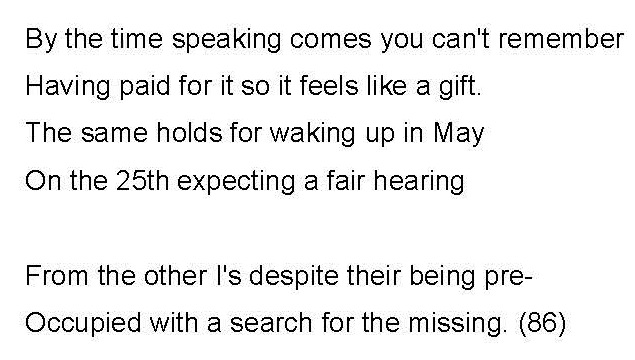
When O’Brien compares speaking, so natural and human and simple, to the delayed arrival of a package, he points out that even the gifts which seem generous and innocent can distance the recipient from the difficulty and expense of their production: “Each subscription set is $40 / But part of what you get is the sense / They’re free by the time they come because / You’ve forgotten paying for them” (83). The time inbetween the creation and the delivery is what invisibly politicizes this exchange, and the speaker of the poem experiences alienation from the purchase of poetry journals as a happy accident, a positive effect of time’s passing. Daily life becomes valuable through waiting, which replaces the anticipation of something to come with a sense of eventual surprise. In the second half of this passage, too much anticipation serves nobody well. The nervous expectation for a fair hearing is unfulfilled, and the “search for the missing” is premature—the missing may simply not have shown up for jury duty, instead of being imagined as kidnapped or suppressed. “pre – / Occupied” rings out with two meanings, reminding us that the recruitment of others in support of one’s cause must await the right conditions (perhaps the Occupy movement) and cannot get ahead of itself. These lines, in comparing mail orders with the desire for justice, reveal how political change might clash with the relaxed transactions of the everyday.
Sunday is the epitome of such relaxation, not only a day of the week but also a mode of living, and the book takes its title from Curt and Robert Siodmak’s 1930 film made from footage of non-professional actors on the day of rest. O’Brien composed the long title poem whilst watching scenes from the movie on Youtube, transitioning from one stanza to the next with each clip. The performers who appear “in front of a camera / Are missing in a saintly way, statues with lives” (70). Who are these missing, who keep reappearing throughout the text? Privacy and quietness characterize both people on Sunday and their hurried counterparts on Monday:

The buildup of concrete nouns lodged in prepositional phrases distracts from the bigger picture of the day, the white sky, and is its own kind of grammatical “forgetfulness”, not “trivial” in the sense that it has no consequence but because it implicates people in spending days trying to recover from minor moments of inattention. And this is exemplified by the final two lines, when having paid for something in person, unlike ordering by mail, produces a moment of anxiety resolved by the ghostly “it” that gestures at an anonymous worker responsible for returning the commodity to its owner. Yet this does not reduce to the buyer’s ignorance of the seller, or the neglect of other identities on the part of the rich. Elsewhere, O’Brien suggests that a class of regular people are also voluntarily missing from public life. Everyone, in fact, now wants to “wander unaccosted”:

One is reminded here, at the beginning of “Hesiod,” of fortune telling by the “dark circles of potential” but also of the magical transformation of the landscape into a hub for the flow of finance. Since capital and its forms of collective activity are “encroaching” on us more than ever, so that even deserts are filled with tall buildings, it has become hard to move around the world without spending money or to find a place to be alone – as the economic punning on “unaccosted” makes clear. An attention to geography and environment is skewed into something unusual and melancholic throughout the poem, nearly a parody of the nature writer’s immersion in his surroundings. The poem moves from a flowing figure of poetic utterance (“he who emits a voice must think / About those streams already running”) to a mind filled with news of “arid conflicts” sounding on the car radio during a journey back from the office (40). O’Brien’s project is to reconnect us in some crucial ways with the mundane and isolating spaces of our own real lives, from which caring about politics and generally being a more aware subject – even whilst driving home from work – can start.
Perhaps the most definitive and remarkable aspect of this book is the time it devotes to normal life, careful to energize rather than idealize the quotidian: “Do not at 10.a.m. / While early heat flows tenderly in / Imagine that a pattern forms in how / Drab birds fly by like news, typical / Shadows this time of year” (49). A loosely knotted syntax meanders into the warm enclave of that second clause, as if the sentence has lost its way until it picks itself up and resumes in the imperative mood. We should not always make leaps of the imagination, these lines imply, because certain kinds of experience are unmappable in symbolic or emotional language because of a sort of excess of mundanity. O’Brien is beautifully patient with writing about these states, to the extent that some passages may strike readers as jokes that have run on beyond their punchlines: “But from the 1st / To the 4th space will involve you / In gradual commitments, packaging / Materials there long after the fact / Has laid out half the audience” (44). But such gradual commitments are just as likely to inform our politics as attempts at one revolutionary event, whose purifying flame may in fact take us away from the material details of our ongoing lives. In People on Sunday politics cannot be extracted from its most narrow, ritual repositories: “the unavailable / Pauses rain again falls out of / Like tinsel” (46).
Two excellent poems at the end of the collection demonstrate the hidden politics of small moments, and of artworks. “Six Political Criteria” turns painterly visions against one another in a manner that is both lush and violent, giving perspective to the drone attacks carried out in the Middle East: “Yellows bought short, rejected / On the shoulders of the next / Embroidered ray, threads of green / In order beyond number. And / A long gold bank of whites” (94). Not only does the military craft see things impressionistically, but each of the colors also enter threateningly into the shorthand of a racist regime, protecting itself behind “threads of green” whether we’re talking about money or army uniforms. The language of scenic description now becomes part and parcel with the arsenal of state power. Even the organic cycles of nature and landscape begin to be experienced in ethical terms, and what seems wholly aesthetic is given larger social appeal. For example, in the penultimate poem “Winterreise”, the images and motions of waves, streams and leaves model an understanding of resistant action:

The “echoing term or a wave” and the lines repeated over stanza breaks allude to the human microphone technique used by protesters in the Occupy demonstrations, as a means for delivering speech through a mass of people. Each time a line is repeated at high volume it should reach a larger group, but the refrains in this poem are only restated once and the scope of the text is limited to a temporary exchange between poet and reader. When people are many their words sound in waves but when they are sparse they talk in discrete terms. O’Brien links this distinction between individual and collective expression in the 21st century to an image of light, also measured in small molecules or large waves, and elsewhere in the poem we find phrases in which the ersatz is mixed with the earthly: the “evictable season” may refer to the aftermath of California’s recent housing bubble and False Dawn is also the title of the philosopher John Gray’s 1998 critique of global capitalism, while the mention of a “stream you didn’t have to be / There for” suggests the digital flow of news to members of a distracted populace, resigned to received wisdom as opposed to embodied struggle (97). This play between natural and historical meanings reaches a kind of apex in “the paper of the sycamore”, which carries both the sense of foliage that adorns a tree and the text that is made from it for the production of books. Whether as light through the leaves or eyes across the page, People on Sunday makes a virtue out of “only passing through.” How are we to fill in the negative space between the private and public, the lasting and the transient? To answer these questions, so relevant to contemporary movements trying to pick up speed, is not O’Brien’s goal. He holds this space open as a site for thinking about other people, in whatever small allotment of time we make available.
References
Hejinian, Lyn. “The Rejection of Closure”. The Language of Inquiry. Berkeley and Los Angeles: U of California, 2000.
Schoonebeek, Danniel. “Desperate Leisure: Ten Questions with Geoffrey G. O’Brien”. The American Reader.
Eliot D’Silva studied English at Cambridge and recently completed an MA at McGill University. He also writes poetry.